The old bottleneck was production
Writing the code, document, analysis, plan, or message often constrained how much work could be attempted.

Agent capability is becoming abundant. Human attention, context, and responsibility are not.
Machine execution can scale. Consequences do not automatically transfer with it.
As people use more agents, they inherit coordination debt across sessions, decisions, tools, and unfinished work. As execution gets cheaper, the useful unit shifts from tokens consumed or runs completed to outcomes actually achieved and accepted.
01 · The world change
For many well-scoped tasks, machines can now produce plausible code, documents, plans, and analyses in minutes. The cost has not disappeared. It has moved into understanding assumptions, reconciling contradictions, reviewing consequences, and knowing whether the work changed anything that mattered.
I first felt this while building and operating more than 30 production agent instances at Atlan. Starting another run was easy. Remembering why it existed, moving context between tools, detecting a waiting decision, and checking whether the original problem was actually resolved remained human work.
Suyash encountered the same structure while running a design studio and training for an Ironman: more tools could produce more information, but no system could reliably decide what mattered now, what could wait, or what no longer deserved to be carried.
The transition is larger than coordination. Capability is becoming abundant while comprehension, attention, legitimate authority, and accountability remain finite. That is the constraint system Waldo is investigating.
Writing the code, document, analysis, plan, or message often constrained how much work could be attempted.
Understanding what changed, checking the result, accepting it, and tracing its consequences remain scarce.
Failure mode
More tokens, sessions, commits, and artifacts can increase visible activity while leaving the person with more uncertainty and review.
02 · The problem pool
AI is not creating one neatly contained problem. It is producing a reinforcing pool: more output raises evaluation load; more agents raise management work; fragmented memory raises reconstruction; easier action raises governance and consequence; cheaper intelligence raises the need to decide what the spend actually bought.
The center of gravity is epistemic. Waldo should help a person know what is true, what changed, what remains, and why—not orchestrate for its own sake. Coordination, memory, and interfaces are candidate means.
Epistemic
Abundance without comprehension. Activity without outcome truth. Memory without coherent continuity. Cheap intelligence without allocation discipline.
Attentional
Delegation without management capacity. Adoption without the agent-management literacy most people never asked to acquire.
Custodial
Personalization without durable user agency: context, corrections, permissions, and history become provider-bound or opaque.
Accountability floor
Agents can act, but legal, social, professional, and moral accountability does not automatically transfer with execution.
The problems reinforce one another. More delegation creates more sessions; more sessions create more reconstruction and review; weak review creates false closure and consequence debt; that burden encourages another orchestration layer that can itself create more activity.
Waldo must break that loop. If it raises sessions or raw artifacts opened per accepted outcome, or interruptions per accepted outcome, it has merely relocated the burden.
03 · Current connective hypothesis
One human intention can span many sessions, specialist agents, tools, people, and days. Provider memory can preserve a transcript; it does not necessarily preserve why the work exists, what changed the plan, what was accepted, or which consequence still remains.
Responsibility continuity is our current hypothesis for that connective tissue. Waldo should retain the desired result, current constraints, authoritative sources, corrections, decisions, unresolved consequences, and the smallest truthful re-entry point—even as the executor changes.
This does not mean giving everyone an operator console. The person should not inherit the skill of managing an agent fleet. Waldo should compress routine discovery, briefing, monitoring, reconciliation, recovery, and re-entry, then surface uncertainty, changed scope, irreversible effects, cost, or permission only when human judgment is truly required.
The hypothesis remains replaceable. If native providers absorb this burden, if people prefer direct control, or if the representation creates more cognitive load than it removes, Waldo must change rather than defend the label.
Preserve
Carry the causal story across sessions rather than storing an undifferentiated transcript archive.
Compress
Absorb coordination work without hiding uncertainty or silently taking authority from the person.
Return
Bring back the relevant artifact, its consequence, and the exact judgment required—not another feed of machine activity.
04 · Current system
builtKennel, a durable harness, and Waldo mobile are working internal foundations. Their integration, external product behavior, and market validation remain open work.
Kennel has the strongest internal acceptance record: attributable Codex sessions, conversation history, live processing state, same-task continuation, first-message handling, and archive cleanup.
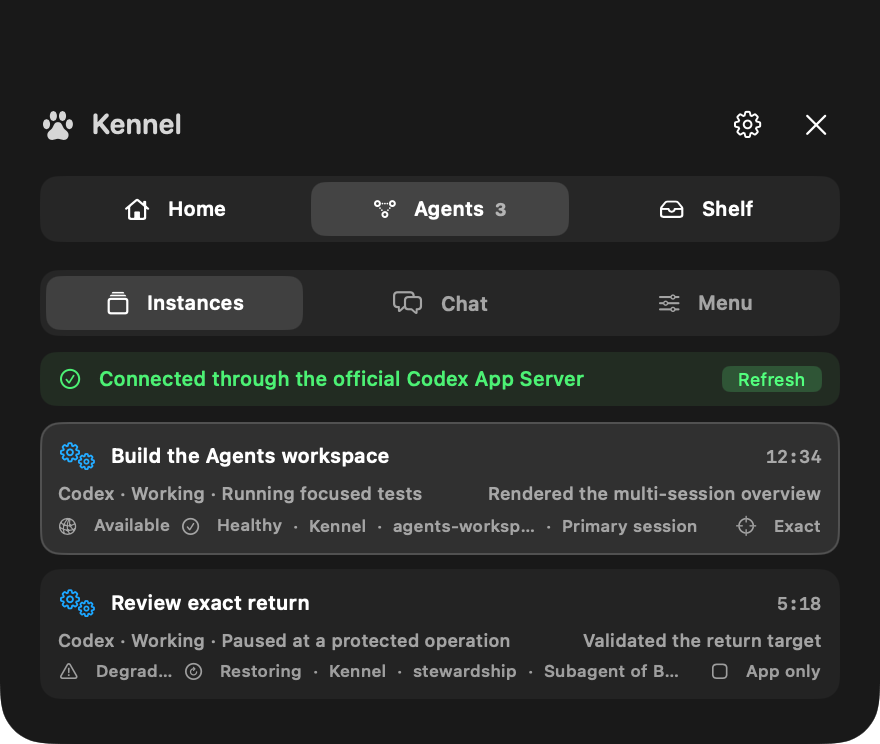
We start with Kennel on the Mac, where the problem is already acute for people running multiple coding agents. Kennel absorbs session-level coordination and brings back what changed, what is supported by evidence, what needs judgment, and what remains open.
Waldo is the layer above it: one private, user-owned personal agent designed to carry intent, context, permissions, memory, commitments, and responsibility across agents, tools, work, and life. Models and interfaces can change; Waldo remains on your side.
Current product
Kennel, Waldo mobile, and the harness demonstrate separate parts of the relationship internally.
Target product
The same user-owned relationship should carry responsibilities across models, tools, services, devices, and contexts.
First wedge
Start where AI-output overload, review, judgment, and follow-through are already visible and painful.
05 · One relationship
Your life and your agents should not belong to two different systems. Personal assistants and work orchestrators have evolved as separate products, even though the user is the same person. Calendars, messages, reminders, commitments, and daily administration should not belong to a different identity from the sessions, runtimes, tools, budgets, and policies involved in getting work done.
I don’t believe one model or interface will own our entire digital life. People will use many models, specialist agents, tools, services, and devices. Waldo is being designed to join personal assistance and work orchestration around the same Outcome, authority boundaries, source material, and continuity.
An organization may own some infrastructure. The individual should own the continuing relationship. Models, tools, employers, and surfaces can change; the context a person chooses to share, their permissions, corrections, responsibility history, and unresolved work should remain with them.
The models may be rented and replaceable. What should compound for the person is their context, corrections, permissions, procedures, responsibility history, and accepted outcomes. Waldo is being built to keep that intelligence on the person’s side even as the machinery underneath changes.
Over time, that same relationship can move beyond the chatbox into mobile, voice, wearables, ambient devices, and eventually physical interfaces. Those are presences of one user-owned personal agent—not disconnected assistants that make the person rebuild context every time. One agent. Many presences. Still yours.
Context
Each agent or tool should receive the smallest attributable view required for the current Outcome—not an indiscriminate memory dump.
Continuity
Work, life context, corrections, and outcomes should stay connected without being trapped in one provider.
Portability
The person should be able to change models, tools, or employers without abandoning the context and outcome history they own.
06 · The product constitution
An agent waiting five minutes is inexpensive. A person reconstructing context across five agents, reviewing unchecked changes, and finding the correct terminal is expensive. Infinite machine capacity does not create infinite human attention.
Burnout is not a feature category. It is a product constraint: Waldo should not make people supervise more software, monitor more feeds, or remain permanently available. It should carry routine responsibility quietly and return only when timing, consequence, or authority belongs to the person.
Success means less mental reassembly, fewer silently decaying commitments, a realistic next action when capacity changes, and permission to decide that enough is enough.
After interruption
Restore the goal, last confirmed state, unresolved decision, artifacts, and smallest next action.
Before it decays
Carry forward what still deserves attention without turning every loose end into an alert.
When capacity changes
Respect what the person says about their capacity and help reduce, defer, or renegotiate the plan.
At the end of the day
Reconcile what became true and carry forward only what still deserves the person’s attention.
07 · What I believe
ChatGPT or Claude can answer what you ask. I want Waldo to understand why you need it, when it matters, what it affects, and whether it was actually resolved. The current prompt is only one fragment of a person’s priorities, relationships, boundaries, capacity, corrections, and commitments.
Life is already distributed across calendars, messages, files, health systems, models, tools, and other people. Waldo should help carry it forward without making the person rebuild themselves—or become the integration layer—every time the interface changes.
The chatbox made intelligence available. It cannot be the whole interface for asynchronous work, and ordinary people should not have to become natural-language programmers or agent managers to benefit. The next layer is continuity, timing, permission, and closure: proactive enough to prepare what matters, but never presumptive about consequential action.
Person before prompt
The request is only one fragment of the person’s intent and circumstances.
Action over dashboards
A feed, chart, or score that hands the coordination burden back to the user is not enough.
Agency over lock-in
The person should be able to inspect it, correct it, change providers, and release what no longer matters.
08 · Principles I won’t trade away
More execution should never mean less agency. We are building Waldo’s working foundations and target architecture around a human rule: continuity must be inspectable, correction easy, and authority fail closed.
Waldo should learn from what a person says, the corrections they make, and outcomes they confirm. Explicit self-knowledge should outrank behavioral inference; activity should never become a hidden personality score.
Human closure
A green check, stopped process, commit, or final message can describe the run. Only the user can close the real obligation.
Proactivity
Low-risk assistance may be proactive; consequential action must stay within visible permission.
Durable responsibility
Replaceable models and temporary screens still need an inspectable record of intent, action, result, and consequence.
Personal memory
The user must be able to inspect, correct, export, delete, and revoke what Waldo carries. Memory must never silently become permission.
09 · The strategic map
I see three connected pressures, but I do not treat them as three equal markets. AI-output overload is the customer problem we can attack now through Kennel. Burnout and finite human capacity are the constitution for how Waldo should behave. Physical AI is the expansion horizon where the same questions of permission, interruption, and recovery become more consequential.
The confidence is different too: the overload and burnout problems are already visible; the physical-world tailwind is strong, but Waldo has not yet validated a hardware product or customer wedge there. The wider curve is consumer: capable intelligence is becoming cheap enough to move agents from specialist tools into everyday products.
Notion’s 2026 workplace survey offers a useful directional signal: 88% of respondents placed themselves or their organizations in its thought-partner or assistant stages, while 71% of AI Users said they would use AI more if they trusted it not to make mistakes on important work. Among more advanced users, automation and cross-tool routing rose—but so did tool sprawl, difficulty seeing real impact, and inconsistent model performance. For surveyed decision-makers, the largest implementation gaps between early and advanced groups were integration, governance, and defined measurement. That is the opportunity Waldo is building toward: not more access to AI, but a person-owned layer that makes distributed AI work coherent, governable, and easier to inspect.
Swipe or use the arrow keys to compare all four columns.
| Pressure | Strategic role | Waldo / Kennel fit | Confidence |
|---|---|---|---|
| AI-output overload | Immediate customer problem | Kennel’s current wedge | High |
| Burnout economy | Product constitution | How Waldo should behave | High problem · medium market |
| Physical world | Expansion horizon | Bodies for AI pathway | High tailwind · low current validation |
10 · The interface lesson
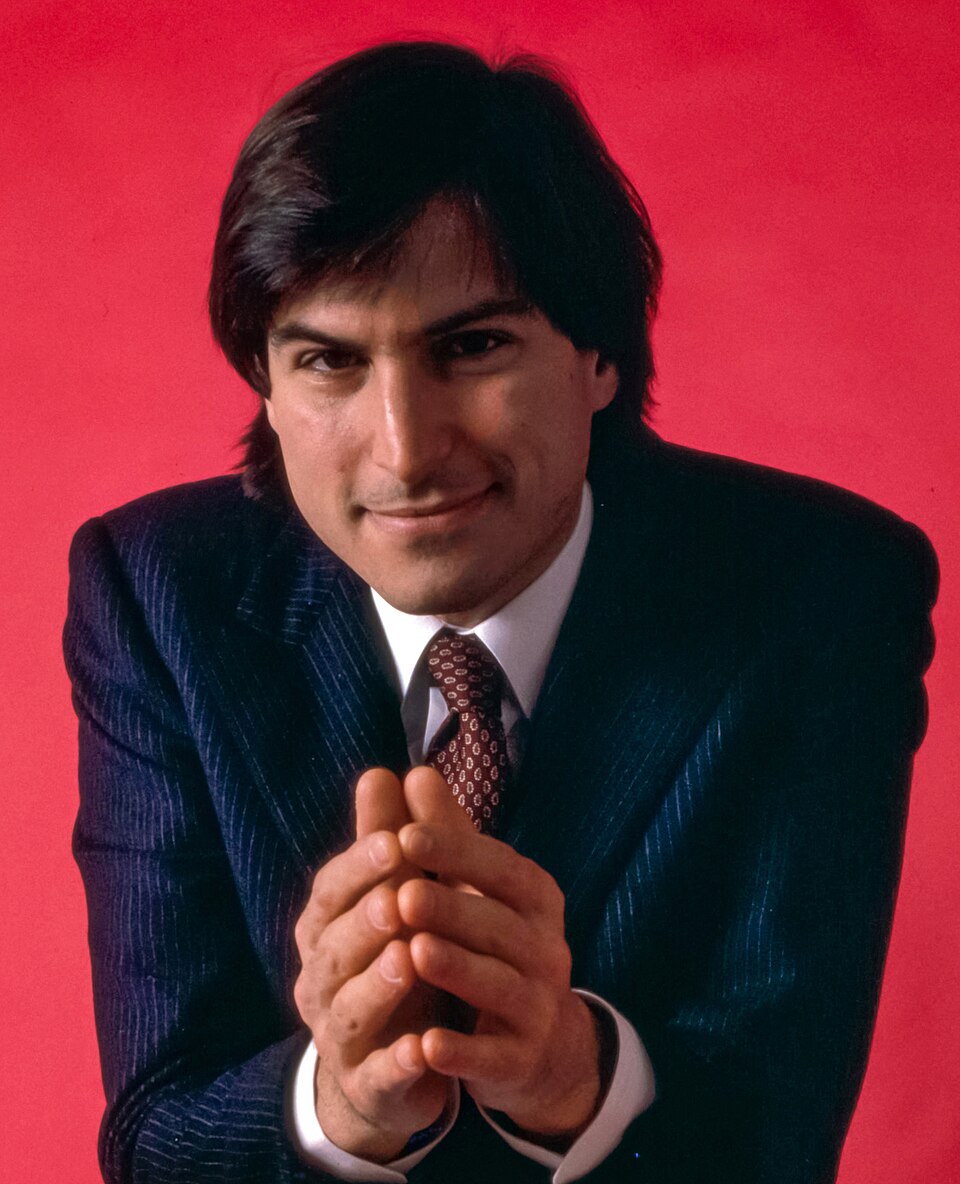
Steve Jobs and Steve Wozniak helped turn computers from something hobbyists operated into something ordinary people could make part of their lives. I see agents at the same interface transition: the capability exists, but using it still asks people to think like operators.
Today, the personal-agent stack still asks people to assemble models, repositories, memory systems, skills, scheduled jobs, credentials, and agent harnesses. This is the Apple I moment. Waldo’s job is to turn that machinery into one understandable relationship: give it a responsibility, and return only when judgment or permission belongs to you.
A line Jobs wrote about the Macintosh stays with me: “It’s our job to make complex technology easy to use and fun to use.” Waldo is my attempt to do that for agents without hiding intent, consequence, control, or who remains responsible.
11 · The expansion horizon
I keep returning to bodies for AI: physical forms people would actually welcome into daily life—a desk object, wearable, home device, vehicle, or small robot. The same Waldo should inhabit each of them, carrying one identity and permission system instead of making every object another disconnected assistant.
The physical-AI tailwind is strong, but this is not a current Waldo hardware program and we have low current customer validation for it. Software comes first because identity, correction, permission, interruption, revocation, and recovery must work before a personal agent is trusted with sensors, movement, or physical authority.
Health and body context is optional and permissioned: a person may choose to share it, but it is neither Waldo’s product category nor a prerequisite. The form may change. The person it works for should not.
A desk
An object that can speak, listen, and carry context without demanding another screen.
A body
New senses and forms for the same user-owned agent, under the same personal policy.
Eventually
Physical forms made for ordinary life—not only factories, warehouses, and industrial autonomy.
12 · Who I’m building with
Ashish and I became friends at school over a shared obsession with iOS jailbreaking. Years later, I met Suyash in the Computer Center at IIITDM Jabalpur and showed him how to build a website by describing it to an AI coding tool. Waldo is the first company the three of us are building together.
Founder · AI systems & engineering
Leads agent architecture, infrastructure, and engineering. Previously built and operated 30+ production agents at Atlan; also worked on Indic language-model data, open-source GovTech, and a from-scratch Qwen3 MoE implementation.
Founder · Product, experience & brand
Leads product, experience, brand, and design. His experience running a design studio while training for an Ironman helped expose how much work and life context still had to be coordinated in a person’s head.
Founding Engineer
Spent nine months working as an AI engineer before joining Waldo. He built much of the first app, including its permissioned health-context pipeline, and now works across native iOS, Supabase, and agent infrastructure.
13 · Public artifacts
The founder video, technical brief, website, product imagery, and essays are demonstrated public artifacts. They make the thesis and current foundations inspectable; they are not proof of integrated external product behavior or market validation. External sources support the direction, not Waldo product-market fit.
Founder video · 01:13
Shivansh and Suyash on the problem, the personal-agent thesis, and why this team is building it.
Open founder video Opens in a new tabProduct video · Earlier chapter
An earlier mobile product chapter preserved as product history. Kennel and user-owned continuity are the current wedge.
Open product video Opens in a new tabResearch · Outcome truth
The distinction between a session, artifact, evidence, accepted outcome, and unresolved human responsibility.
Research · Memory
A design position on provenance, scope, contradiction, correction, authority, and forgetting in a persistent personal agent.
Research · Harnesses
A synthesis from studying more than 40 public agent harnesses, with the production-versus-research boundary kept explicit.
Technical & vision brief
The system model, current foundations, permission boundaries, architecture, and longer physical-AI direction.
Product site
The public product story and the earlier interaction system that led to today’s Kennel-first direction.
External signal · Paras Chopra
Paras Chopra frames agent use as learned delegation: discovering what to hand off, briefing it, supervising it, recovering from failure, and absorbing risk. His conclusion sharpens Waldo’s product test—the agent must reduce that cognitive cost behind interfaces ordinary people already know how to use.
External research · Notion
Notion’s 2026 survey of 6,118 AI decision-makers and active workplace AI users found 88% still in its thought-partner or assistant stages. Among decision-makers, the largest advanced-versus-early gaps were integration, governance, and measurement. It supports Waldo’s problem framing—not consumer product-market fit.
External framework · Notion
Notion’s companion model traces the move from ad-hoc prompting to recurring cross-tool agents and multi-agent systems. At the higher levels, checkpoints, permissions, monitoring, policy, incident handling, orchestration, and governance become part of the product—not back-office details.
External signal · Andrew Chen
Andrew Chen describes the shift from AI that assists to agents that act—and the frustration of receiving more work to review. Waldo’s answer is not action alone: acceptance tied to visible artifacts, human judgment, and continuity the user owns.
External signal · Y Combinator
YC gave individual employees personal agents, then built QM when managing the fleet became difficult. QM is the organizational answer. Waldo asks the personal question: as agents multiply across work and life, what keeps your context, permissions, judgment, and accepted outcomes coherent—and on your side?
External signal · Garry Tan / YC
At Startup School 2026, Garry Tan described personal AGI as a person-controlled combination of context, memory, reusable skills, and a replaceable agent harness. It is a strong external articulation of Waldo’s ownership curve. Waldo is being designed to extend that thesis through purpose-bound context, exact authority, Outcomes tied to visible artifacts, and an interface that does not require people to operate the underlying agent stack.
External signal · LangChain
LangChain argues that companies should control the model, harness, context, and memory that shape an agent—and the learning loop that compounds with use. Waldo asks the personal question: how can one person keep that context, memory, authority, and continuity portable and on their side as models and tools change?
External signal · YC RFS
YC’s Fall 2026 RFS argues that intelligence is becoming capable and cheap enough for everyday products across how people get things done, learn, stay healthy, and connect. Waldo is being built into that curve as one user-owned agent across work and life.
Historical reference · Steve Jobs Archive
In his 1999 Macintosh anniversary email, Jobs described Apple’s role as bridging sophisticated technology and ordinary people. That interface lesson shapes how I think about making agents useful beyond today’s hobbyists and operators.
Many agents can work for you. One agent should know you, stay with you, and care whether the outcome actually became true.